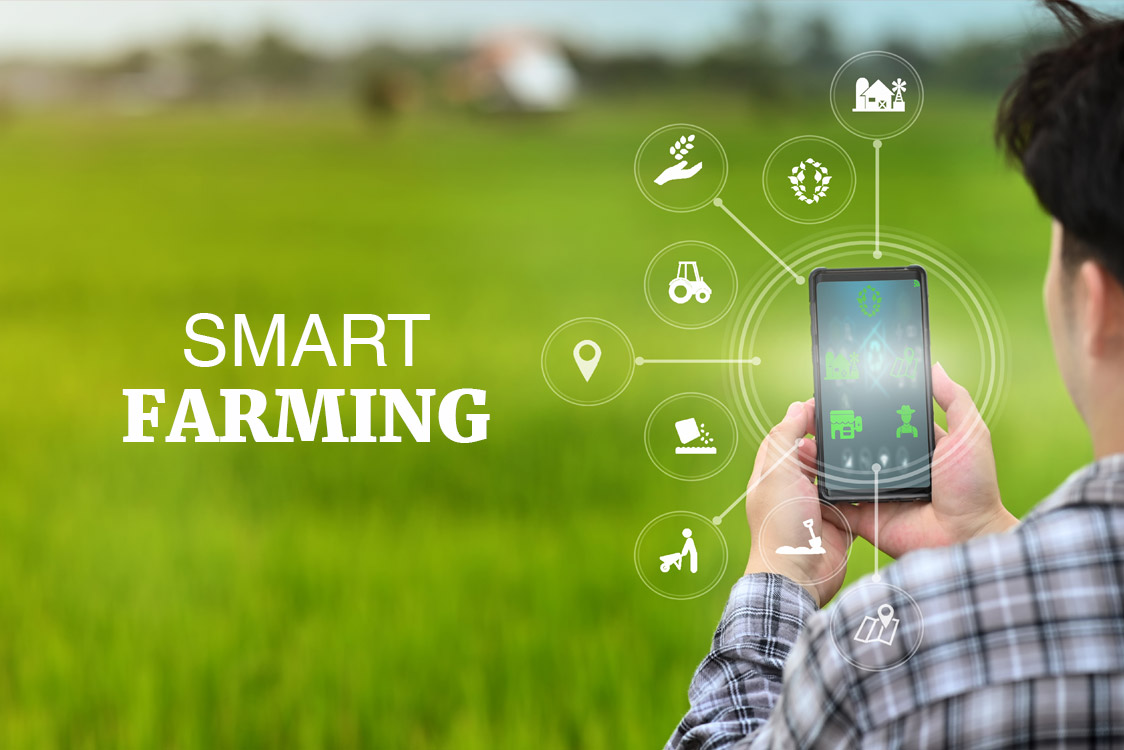
Due to increased food demand, farming is also moving faster towards technology use. Long back, farmers were using mechanical instruments for farming, but in the 20th century, innovation made farmers’ lives easier. Let us understand together how IoT is helping in agriculture to improve farm production.
Applicability of IoT in Agriculture:
Smart Farming could be a high-tech and effective system of doing agriculture and growing food in a proper way. It’s an application of implementing connected devices and innovative technologies into agriculture. Good farming majorly depends on IoT, eliminating the necessity of physical work of farmers and growers and thus increasing productivity in a sustainable manner. We will see that the application of IoT in agriculture is increasing day by day.
With the recent agriculture trends cited by agriculture, the Web of Things has brought large advantages like economical use of water, improvement of inputs, and plenty more. What created the distinction was the massive advantages, and that has led to a revolution in agriculture in recent days.
IoT, primarily based on good Farming, improves the entire agricultural system by monitoring the sector over a period. With the assistance of sensors and interconnectivity, the Internet of Things in Agriculture has not only saved the time of the farmers but has also reduced the extravagant use of resources such as Water and Electricity. It keeps numerous factors like humidity, temperature, soil, and so on under check and provides a crystal-clear, real-time observation.
Agricultural Drones:
Technological advancements have nearly revolutionized agricultural operations, and the introduction of agricultural drones is the trending disruption. The bottom and Aerial drones are used for assessment of crop health, crop monitoring, planting, crop spraying, and field analysis. By implementing the correct strategy and utilizing supported time-period data, drone technology has significantly transformed the agriculture industry. Drones with thermal or multispectral sensors determine the areas that need changes in irrigation. Once the crops begin growing, sensors indicate their health and calculate their vegetation index. Eventually, good drones have reduced the environmental impact. The results specify that there has been a huge reduction and much lower chemical levels reaching the groundwater.
Climate Conditions:
Climate plays an awfully vital role in farming. And having improper information regarding climate heavily deteriorates the amount and quality of the crop production. However, IoT solutions help you understand the period of time and climatic conditions. Sensors are placed within and outdoors of the agricultural fields. They collect information from the atmosphere that is employed to decide on the proper crops that may grow and sustain within the specific climatic conditions. The full IoT scheme is created from sensors that will see real-time weather conditions like humidity, rainfall, temperature, and additional very accurate data. There are numerous numbers of sensors offered to sight these parameters in the associated Nursing piece, consequently to fit your good farming requirements. These sensors monitor the condition of the crops and also the weather close to them. If any troubling climatic conditions are found, then an alert is sent. They aim to eliminate the need for physical presence during adverse climatic conditions, which would ultimately increase productivity and help farmers gain additional agricultural benefits.
Precision Farming:
Precision Agriculture/Precision Farming is one of the foremost well-known applications of IoT in Agriculture. It makes the farming observation more precise and controlled by realizing smart farming applications such as eutherian mammal monitoring, vehicle pursuit, field observation, and inventory monitoring. The goal of exactitude farming is to investigate the information generated via sensors and to react accordingly. Farming helps farmers to come up with data with the assistance of sensors and analyze that data to make intelligent and fast decisions. There are varied precision farming techniques like irrigation management, livestock management, vehicle tracking, and plenty of others that play a significant role in increasing the potency and effectiveness. With the help of exactitude farming, you’ll analyze soil conditions and different connected parameters to extend the operational efficiency. Additionally, you can monitor the operating conditions of the connected devices over time to detect water and nutrient levels.
Smart Greenhouse:
To build our greenhouses smart, IoT has enabled weather stations to mechanically alter the climate conditions in step with a specific set of instructions. Using IoT in greenhouses has removed the need for people to get involved, making the process much more efficient and consistently accurate. For example, victimisation of solar-powered IoT sensors builds trendy and cheap greenhouses. These sensors collect and transmit the real-time information that helps in monitoring the greenhouse state thoroughly, exactly in real time. With the assistance of the sensors, the water consumption and greenhouse gas emissions are often monitored via emails or SMS alerts. Automatic and good irrigation is meted out with the assistance of IoT. These sensors help to produce info on the pressure, humidity, temperature, and light levels.
Conclusion
IoT-enabled agriculture has helped implement trendy technological solutions to time-tested knowledge. This has helped bridge the gap between production and quality and the amount of yield. Information is gathered by getting and commercializing information from multiple sensors for real-time use or storage, during a info ensures swift action and less harm to the crops. With seamless end-to-end intelligent operations and improved business method execution, turnout gets processed quicker and reaches supermarkets in the quickest time possible.